
You can stumble on the word “Soutaipasu Insights on VVYManga” in online forums, coding tutorials, or even cultural discussions – and wonder, “What does it mean on Earth?” Despite its unfamiliarity, the word carries many colors of meaning, rich with each reference. Whether it is a tech jargon, cultural metaphor, or symbolic language, Saupipasu invites us to the world of accuracy, adaptability, and layered understanding.
In this article, we will find out:
1. Literally as “relative path” in tech
2. A metaphor- its symbolic power in cultural and creative contexts
3. Why Soutaipasu’s idea matters – technical, professional, and philosophical
Let’s dive
1. Soutaipasu in Technology VVYManga paths that are favorable and tolerant: Relative

At its most grassroots level, soutaipasu computing is a Japanese VVYManga term that corresponds to the English word “relative path”, which is written in Romaji (Romanized Japanese) and usually represents the “relative path” (相対パス, sōtai pasu).
What does it mean? Imagine adding files without relying on rigid, absolute file paths that break when they’re used. Instead, a relative path lets you say, “C: see” images/logo instead of “C: /users/Project/images/logo.png”. “This is compatibility. If the entire project folder is moved, the link still works— as long as the internal structure remains intact.
This flexibility makes Soutaipasu a developer’s friend, especially in web or software projects shared in various environments. Whether you are working locally, on the staging server, or through a cloud platform, your links and resources are connected using relative paths- even when the project runs. It is both skilled and flexible.
2. Why Soutaipasu VVYManga matters: soft power of flexible references
Port
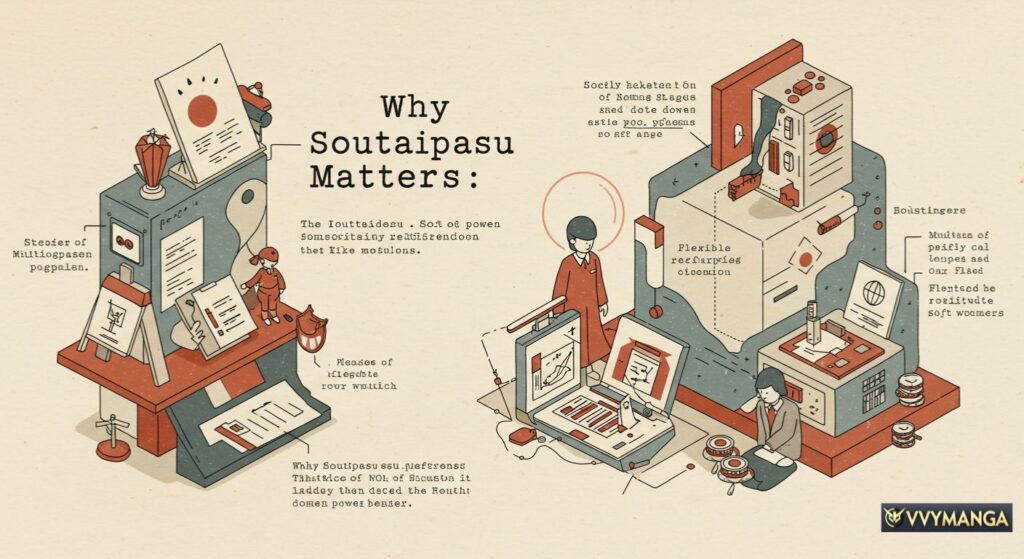
Projects manufactured using the soutaipasu VVYManga principles can be moved, cloned, or shared without breaking links. It is a boon for developers working across multiple machines or systems, especially in environments that utilize version control or coordinate through shared drives and cloud platforms.
maintenance
When the website’s property VVYManga (such as images, styles, scripts) relies on relative paths, the restructuring or reorganization of the directory structure becomes less painful. You avoid the headache of rewriting every absolute path because the relative paths automatically adjust.
Readability
Let’s face it – reliable paths are easier on the eyes than long, unknown complete addresses. Cleaner code means rapid understanding, fewer typos, and a smooth growth flow.
3. Code beyond: Soutaipasu as cultural and creative metaphor

Interestingly, Soutaipasu has slipped into a symbolic and cultural domain more than its technical origin.
A path that develops
Like the relative paths in the code, Soutaipasu has systematically increased gaming jargon, design discussion, and even entered creative workflows. It stands as a metaphor for flexibility and decision-making based on reference.
For example:
• In gaming, fans discuss complex in-game mechanics with the term, which change based on current conditions, suggesting tricks or strategies. The idea of a “conditional pass” resonates with the adaptability of a relative path.
• In creative or professional contexts, some people explain the soutaipasu as a balanced exchange – where the contribution flows mutually and from flexibility depending on the time.
• On social media, it sometimes surfaces as a symbol of layered meanings – indicating internal formula knowledge or cultural nuances.
It is its best linguistic cross-pollination.
4. Why learning soutaipasu matters – clearly and philosophically
For developers
Understanding Soutaipasu is practical. It reinforces the habits of the good project, promotes error-free movement between the environment, and reduces headaches when cooperation or deployment is required. You are not just writing file path— you are building flexible, adaptable projects.
For creators and professionals
Even outside the tech, the concept of Soutaipasu or VVYManga reminds us that reference matters. Whether you are designing workflows, organizing resources, or sharing a portfolio, a Soutaipasu mindset keeps your work flexible and ready to be prepared, shared, and understood across various platforms.
Culturally, for a curious mind
Soutaipasu also indicates how the language develops. It is a blend of Japanese structure and English agency—an example of how hybrid words emerge to capture concepts that are not easily translated. Learning this makes your praise deeper, as the language can convey a layer of meaning, especially in global or niche subcultures.
5. Practical Tips: Executing Soutaipasu in actionVVYMangaWant to be comfortable with Soutaipasu?
1. Use relative paths VVYManga when adding local files: Think of “picture/logo.png” instead of full system paths.
2. Struggle with your folders logically: Keep the related files closed, make the path comfortable.
3. Working wisely with version control equipment: providing reliability while moving between related tracking systems.
4. Documentation of your workflow: Make sure the collaborators consider how your files refer to each other.
5. Uses across the system: Tests how your paths behave when projects go from Windows to macOS or Linux.
Even if you’re not using code, you can apply this theory by organizing digital assets in a way that remains intact when shared or reshuffled.
6. Frequently asked questions (FAQ)
Question: What is really “Soutaipasu”?
In the heart, it is a Japanese term for a relative path in computing—a link that optimizes by pointing to a particular place instead of a specific location.
Question: Why use it instead of a complete path?
Relative paths are flexible, portable, and easy to maintain. They survive through project moves, system changes, and shared cooperation, all without sharing.
Question: Apart from Tech, where can I see this word?
You can use it in gaming for describing conditional tasks or as a metaphor for adaptable workflows in creative settings. Even the language-lover communities discuss it as a cultural hybrid.
Question: Is Soutaipasu an official Japanese word?
Not in traditional dictionaries. It is jargon from fandom cultures, made by mixing Japanese and English in a way that captures what is not easily expressed.
Q: How can I practice using it?
Use relative links in your projects. Arrange your directors neatly. To verify that everything is still the solution, try moving your project between the folder and the system. This is the real-world Soutaipasu in action.
7. Last Idea: Soutaipasu as a bridge between the world
Although it may look vague at first, Soutaipasu VVYManga is more technical. It is a ball of adaptability, thoughtful structure, and innovation. Ifusion, where files, projects, and thoughts move continuously, understanding of Soutpasu gives you an edge in both code and creativity.
The next time you hold the word in a coding guide or a sub-series post, you will know: it’s not just about the paths – it’s about the routes that flex, fit, and flow.
